Source Authority Signals Recognized by AI Search Engines
Earning AI citations now requires mastery of four trust layers, not keyword rankings.

AI search engines no longer hand back a page of ten blue links, and the consequence for anyone trying to be found is severe. They select a small number of trusted sources, synthesize an answer from them, and name that answer's authors directly. Where this once spread visibility across a list of candidate pages, the shift from ranking to selecting collapses visibility from a list of links to one to three cited brands maximum, and everyone else disappears from the page entirely.
Why AI search engines now filter rather than rank
An AI answer engine works by retrieving a set of candidate documents, then scoring each one by how much usable evidence it contains, and finally quoting whichever source lets it state its answer with specific, attributable detail. A page that claims to deliver "industry-leading results" hands the engine nothing it can lift and cite. A page that states a precise figure, names a method, or cites a dated finding gives the engine a concrete claim it can quote with attribution, which is the actual difference between a page that gets indexed and one that gets cited. ZeroClick Labs' 2026 guide describes this as a shift from earning the click to earning the citation, and the stakes of that shift are higher than they sound, because the buyers reading these answers aren't casually browsing. They are already deep in the decision process of choosing a vendor: a brand that doesn't appear in the AI's answer is invisible at the exact moment a purchase decision gets made.
Trust, not keyword relevance, is now the primary filter
What the engine is scoring for, when it scores candidate documents for evidence, is trust, and trust has moved from being one ranking factor among many to being the filter that determines how every other signal gets read. Google formalized this shift years ago with its E-E-A-T framework, which stands for Experience, Expertise, Authoritativeness, and Trustworthiness, and these four components have stopped functioning as content-quality guidelines and now serve as the organizing logic AI systems use to decide which sources even qualify to be cited. Goodfirms surveyed practitioners across multiple countries in January and February of 2026 and found a dataset that disagreed on almost everything except one point: every single respondent agreed that E-E-A-T will matter more, not less, as AI search grows. That was the only unanimous finding in the entire study. AI Growth Agent's analysis, drawing on data from Semrush, found that E-E-A-T signals correlate with AI citation likelihood more strongly than any other content-quality factor tested, including purely technical signals. The practical consequence is that two companies can publish a similar volume of content and hold similar organic visibility in traditional search, yet land in entirely different places when an AI engine decides whom to cite, and the deciding factor is how clearly each company's trust signals read to the model. That trust doesn't arrive as one undifferentiated score. It builds through a set of distinct layers, each one stacking on the last.
The four-layer signal taxonomy AI engines apply
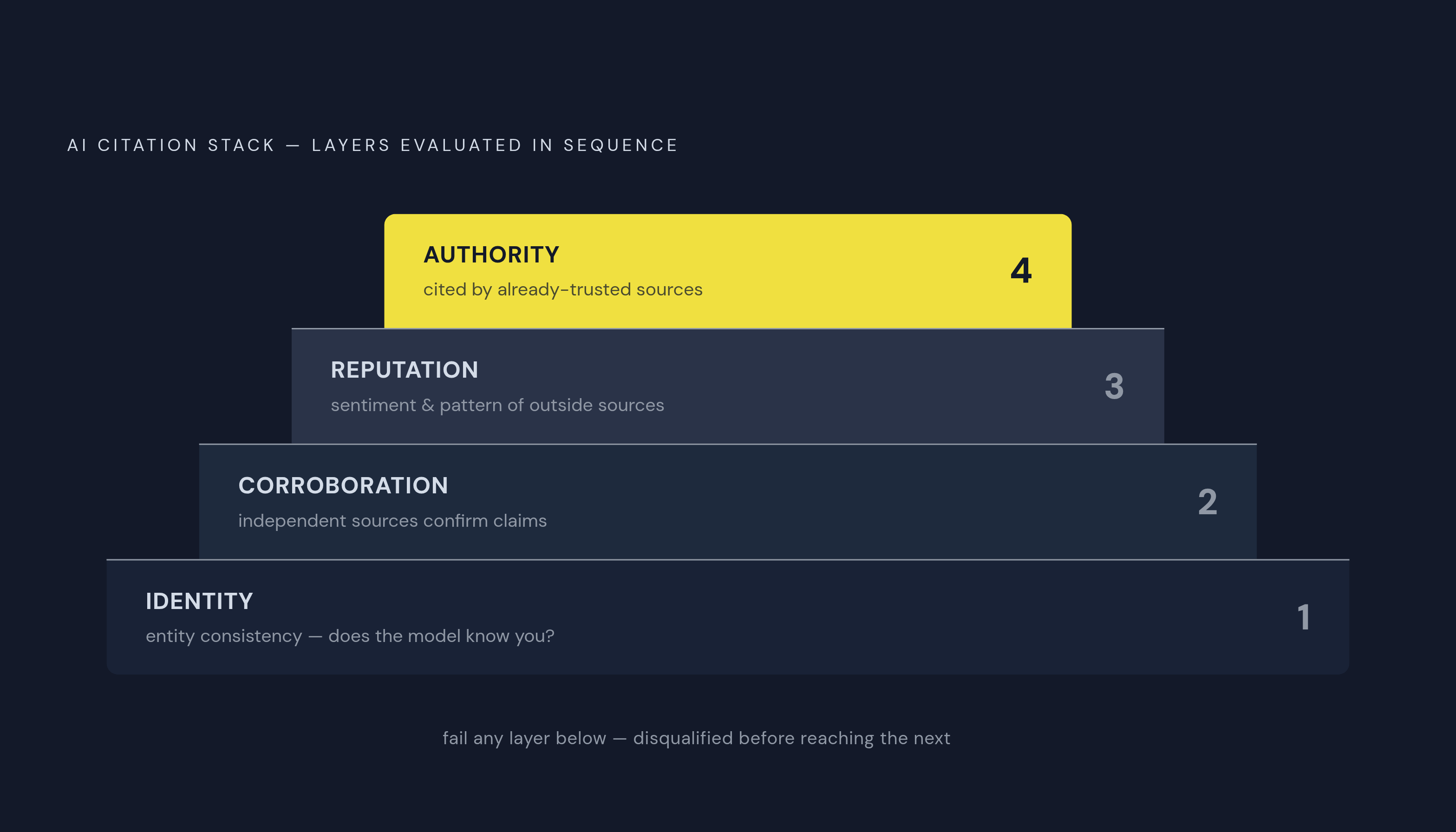
Practitioners and researchers studying AI citation behavior have converged on a four-layer model: identity, corroboration, reputation, and authority. The order matters as much as the content of each layer, because AI engines apply these checks in sequence, and a brand that fails the base layer gets disqualified before the upper layers are even evaluated. The first layer asks a simple question: does the model know with confidence who you are? Entity consistency sits at this base, and without it, no signal above it can reach full weight. The second layer, corroboration, asks whether independent sources confirm what a brand claims about itself, and a fact repeated across several unaffiliated sources carries more weight here than domain reputation alone. The third layer, reputation, looks at the sentiment and pattern running through what those outside sources say, and a consistent, positive characterization compounds in value the longer it holds. The fourth and highest layer is authority: whether a brand is cited by sources the model already trusts, which is the single strongest signal in the stack. Visibility Ops' 2026 blueprint describes the current landscape as entity-based authority rather than link-based authority, a description that lines up exactly with this layered structure. Each of the sections that follow takes one of these four layers and shows what it looks like in practice, starting at the bottom, where most brands first run into trouble.
Entity consistency as the base layer every other signal depends on
Entity consistency means a brand's name, category, founding details, and location read the same way everywhere they appear on the web, and it is both the least-discussed of these signals and the one that disqualifies a source before any content quality gets assessed. Most brands assume their own identity is self-evident to a machine the way it is to a human reader, and that assumption is the first thing this layer breaks. An entity's name or description appearing three different ways across the web lowers the model's confidence in that entity, and a low-confidence entity does not get cited, no matter how good its content is. ZeroClick Labs' guide names authority, entity clarity, and extractability as three distinct citation criteria, and it notes specifically that ambiguous or inconsistent entity signals cause AI systems to pass over a source regardless of how strong its content might otherwise be. The fix sits closer to infrastructure than to editorial work. Entity disambiguation schema, including SameAs and knowsAbout markup and Organization schema that points to outside identifiers like Wikidata, LinkedIn, and Crunchbase, directly improves how well a Knowledge Graph recognizes an entity. Sites with clean entity schema get cited more often simply because the AI can resolve, with confidence, who or what it's looking at, which makes this the one layer in the whole taxonomy where the fix is mostly technical rather than editorial. The failure case is easy to picture and common in practice: a company with genuinely strong content and real expertise uses its full legal name on its own website, a shortened trade name on LinkedIn, and an acronym on third-party directories, and in doing so hands the model three separate candidate entities where there should only be one.
Third-party corroboration and earned mentions
Once an AI engine knows who a brand is, it moves to the second layer and asks whether anyone else confirms what that brand says about itself. A taxonomy of trust signals used in AI citation decisions found that corroboration carries more weight than domain reputation on its own: a brand mentioned independently by many different sources will outperform a brand that holds a high domain-authority score but few outside mentions. This is where the old backlink model, while still relevant, stops being sufficient on its own. A mention doesn't need a clickable link to count. When a high-authority site mentions a brand without linking to it, AI models still register the association, and frequent unlinked mentions of a brand alongside a specific topic on reputable sites teach the model to connect that brand with that expertise. WSI's 2026 article on trust signals states the underlying logic: authority is what others are willing to associate with you, and if no credible source ever references a business, the AI has little reason to trust it, no matter how strong that business's own content reads. This is the point where community platforms enter the picture, and it tends to surprise brands used to thinking of authority in terms of press coverage and editorial backlinks. BusySeed's analysis, drawing on Semrush research, found that user-generated content and community platforms, Reddit, Quora, and LinkedIn among them, rank among the most-referenced sources across AI experiences, and OpenAI's partnership with Reddit, built around access to real-time, unique community content, represents a concrete structural bet on exactly this kind of signal. Which platform a brand is optimizing for changes the calculus here. ZeroClick Labs notes that Perplexity's most-cited source is Reddit, reflecting a philosophy built around recency and community discussion, while ChatGPT's most-cited source is Wikipedia, reflecting an encyclopedic, reference-based philosophy instead. None of this makes traditional backlinks irrelevant. It means they've become one input among several rather than the whole of the corroboration signal.
Verified authorship and original data as the reputation layer
Above corroboration sits reputation, and the two signals that matter most at this layer are named, verifiable authorship and original first-party data, because both give an AI engine something concrete to attribute that anonymous or derivative content simply cannot offer. Content written under a named person with demonstrable expertise carries more trust than content published anonymously or under a generic brand byline, and author schema markup that links to a real professional profile gives the AI a resolvable identity to attach to the claim being made. AI Growth Agent's guide lays out the sequence: assign named authors with author schema across every article first, then back that authorship with first-hand case studies and proprietary data that only the organization in question could have produced. The reason original data carries so much weight is straightforward. It represents knowledge the AI cannot find anywhere else, and a brand that publishes a report built on its own proprietary research becomes a primary source rather than a derivative one, which is precisely the kind of source these engines are built to cite. WSI's analysis frames this as information gain, meaning content that adds something genuinely new instead of restating what already exists, and treats it as a core criterion AI applies when choosing between sources that otherwise look similar. A proprietary survey of a few hundred customers, or an original dataset pulled from a company's own product usage, does more for this layer than another well-written explainer ever could. ZeroClick Labs adds a related point: topical depth now outweighs raw domain authority as a citation criterion, so consistent, expert coverage across a cluster of related topics signals real expertise more reliably than a high aggregate domain score ever did.
Content extractability and structure as the signal that determines citation eligibility before quality
Before an AI engine ever judges how good a piece of content is, it judges whether that content can be pulled apart and reused at all, and this ordering catches most content teams off guard. Structural extractability, meaning whether the engine can parse a passage, isolate it, and reuse it without reading through the entire page, gets evaluated before content quality in the citation sequence, which makes format a prerequisite rather than a finishing touch applied at the end. ZeroClick Labs' guide is direct about the limits of this: structure, schema, and recency make good content machine-legible, but none of them substitute for the content itself, and answer-first writing that covers a full decision arc is still what wins the actual grounding behind an answer. Formatting opens the door; substance is still what walks through it. Listicles, standalone articles, and product pages account for most AI citations because they are the easiest formats for a model to extract from, and lower cognitive load for the engine translates directly into preference. Kevin Indig's research, cited in AI Growth Agent's analysis, found that 44.2% of all AI citations draw from the first third of a page's content, which makes front-loading the actual answer a structural requirement rather than a stylistic choice. In practice, this favors a direct, declarative answer in the first sentence or two of each section, headings phrased as the concise questions a user might actually type, comparison tables in place of dense paragraphs wherever the data allows it, and plain numbered or bulleted lists over long explanatory prose. Technical coherence compounds all of this, since Google's AI Overviews draw from Google's own search index, so Core Web Vitals, HTTPS, and mobile usability all affect whether a page gets indexed as a high-quality source the AI is even willing to pull from in the first place.
Where structured data helps
Practitioners disagree on whether schema markup directly drives AI citations, and the honest answer sits between the two camps that argue it loudest. Many optimization guides claim schema markup directly drives citations, pointing to the fact that a majority of cited pages happen to carry schema as evidence of cause and effect. Many cited pages carry schema, but that correlation isn't proof of the mechanism these guides claim. Schema markup is necessary but not sufficient for AI citation, and its highest-value use lies in entity disambiguation rather than in triggering citations directly, a distinction the largest controlled study on the question has made clear. Schema tells the model with precision who a brand is, what it does, and how it connects to other known entities. That resolves the identity-layer problem discussed earlier. It does not, on its own, make mediocre or poorly structured content more worth citing. The honest way to hold both facts at once: schema earns a brand the right to be correctly understood, and extractable, answer-first content earns it the right to be quoted.
Sources
- How Social Media Signals Fuel AI Search Authority and Buyer Trust in 2026
- AI SEO Statistics 2026: 35+ Verified Stats & 9 Original Research Findings
- 5 Trust Signals That Build AI Search Authority
- AI Search Optimization in 2026: The Complete Guide
- How to Build Authority for AI Search Engines in 2026
- Off-Page SEO, Authority Signals & Link Building in an AI-Dominated Search World: The 2026 Blueprint