AI Overviews Impact on Organic Click-Through Rates
Google's AI summaries are slashing organic traffic to informational content publishers.
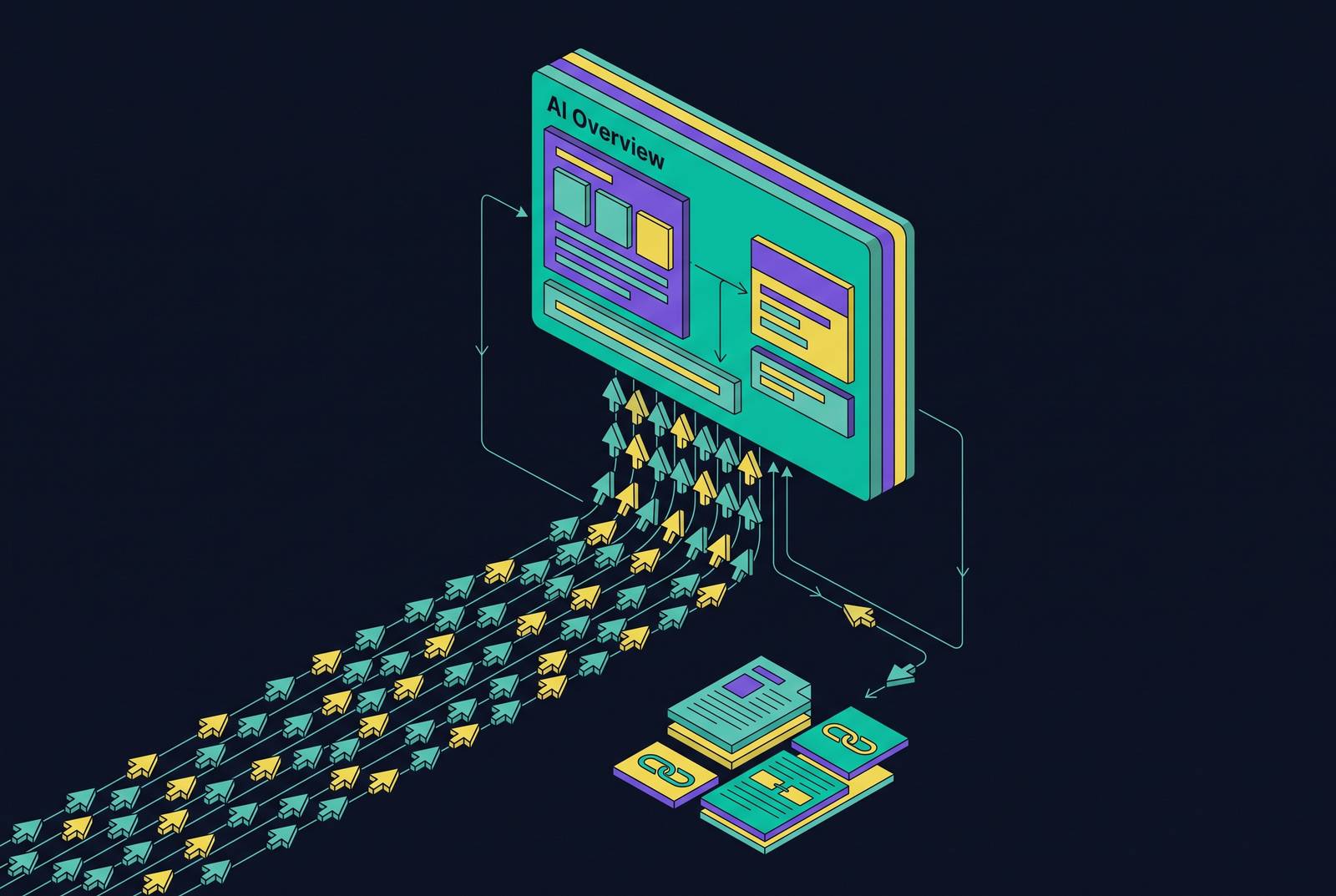
AI Overviews have moved from a visible feature on the results page to a force that now determines how much organic traffic a piece of content can expect to earn. The suppression of click-through rates that follows is severe, uneven, and increasingly difficult to manage with the SEO playbook most content teams already have.
AI Overviews as a structural force in search, not a feature update
The speed at which AI Overviews have expanded rules out any reading of this as a gradual feature rollout that teams can wait out, and marks instead a structural shift in how Google presents information at the SERP level. What's unfolding instead is a structural change in how Google presents information at the results-page level, one that now touches the economics of organic search for nearly every content team rather than just the early adopters who were tracking it on the margins. The change is not evenly distributed. Coverage is uneven by category: BrightEdge data shows Healthcare, Education, and B2B Technology among the highest-saturation categories, industries where informational content has long served as the primary traffic engine. Informational and how-to queries, the backbone of most content marketing programs, now trigger an AI Overview on the majority of result pages, while transactional and navigational searches remain far less affected. That split determines which kind of content strategy is absorbing the impact and which kind is mostly being left alone.
What the click-through data shows across the major studies
Several independent studies, built on different samples and different methods, land on the same directional conclusion: when an AI Overview appears, organic click-through rates fall sharply, and the losses concentrate on informational queries at the top of the results page. Seer Interactive's study tracked thousands of search terms across dozens of client organizations and tens of millions of organic impressions between June 2024 and September 2025, and found that organic CTR on queries with an AI Overview fell by roughly two-thirds over that window, settling at a very low floor by the summer of 2025. Ahrefs' analysis found that AI Overview presence correlated with a 58% lower average CTR for the page ranking first, and the suppression did not stop there: position 2 lost roughly half its expected clicks, and even position 10, far down the page, lost nearly a fifth of its expected share. Pew Research Center's behavioral study, covering hundreds of U.S. adults across tens of thousands of real Google searches, found that users clicked a traditional result far less often when an AI Overview was present, and that clicks on the links embedded inside the overview itself were negligible. A randomized field experiment conducted by researchers at the Indian School of Business and Carnegie Mellon, described as the first of its kind run in a live browsing environment, found that AI Overviews substantially reduced clicks to external websites on the queries that triggered them, even though self-reported search satisfaction barely moved when the summaries were removed. Lined up together, these studies repeat the same pattern: informational queries are the most exposed, the suppression is largest at the top of the SERP, and the click that does happen is increasingly rare. That range itself is the finding, since the figures differ by study and by method and should not be averaged away. It is itself the finding, because it signals that the damage is not uniform, and the next question is where exactly it lands hardest.
The variation behind the aggregate CTR drop
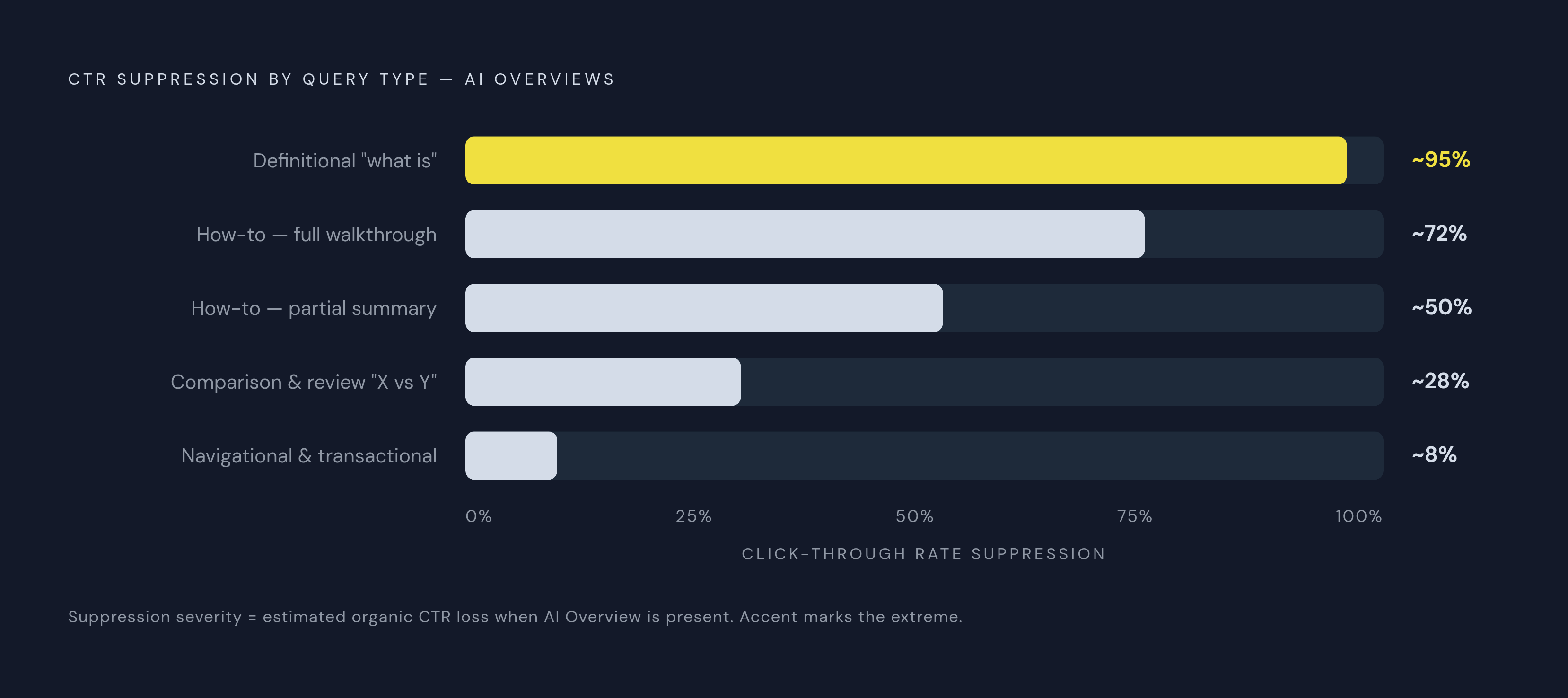
The CTR suppression number dominating most coverage of this trend is accurate, but treating it as a single figure to plan around is a mistake. The real range runs from near-total suppression on simple definitional queries to a far more modest drop on comparison and transactional searches, and which end of that range applies to a given content program depends entirely on what kind of queries that program's content was built to win. Digital Applied's analysis breaks that range down by query type, and the pattern is consistent enough to plan around. Simple "what is" definitional queries see the steepest drops, because an AI Overview can answer them fully in a few sentences and leave the user with no reason to click through at all. How-to content fares differently depending on how much of the procedure the overview actually covers: a full walkthrough inside the summary produces a steep drop, while a partial one, which leaves the user still needing detail, produces something more moderate. Comparison and review queries, the "X vs Y" and "best X for Y" searches that drive much of affiliate and consumer content, see a smaller drop, because summaries exist for these but purchase-intent users still want the deeper analysis a single page can offer. Navigational and branded searches see the smallest drop of all, since a user searching for a brand by name still intends to land on that brand's site. Transactional queries carry relatively little AI Overview presence in the first place, because Google's own systems correctly identify that someone performing a transactional search wants a destination, not a summary. The practical conclusion is that what has broken is specifically the informational content strategy, the guides, how-tos, and comparison pieces that brands have relied on for top-of-funnel traffic, while transactional and purchase-intent queries continue to generate clicks much as before. None of this means a team can simply retreat to queries without an AI Overview and wait the trend out. Seer Interactive's data shows that organic CTR on non-AIO queries has also fallen significantly, down 41% year-over-year by its analysis, after briefly peaking in early 2025 before dropping sharply, a pattern that points to broader behavioral shifts beyond AI Overview presence alone, including users turning to ChatGPT, Perplexity, and social platforms before they ever open Google. The decline in organic search is wider than the AI Overview footprint, and any strategy built solely on avoiding those queries is building on ground that is also eroding.
Publishers and industries that have absorbed the sharpest real-world losses
The sharpest losses have landed on publishers whose entire business model runs on informational, ad-supported content, which happens to be exactly the category where AI Overview coverage is now highest. The Digital Bloom's analysis and Growtika's tracking of Ahrefs data put names and numbers behind that pattern. Digital Trends went from pulling in millions of monthly clicks in early 2024 to a small fraction of that figure by early 2026. The Verge, HowToGeek, and ZDNet each lost more than 85% of their tracked visits at peak. Wired lost roughly three-fifths of its traffic. CNN saw a substantial year-over-year decline in traffic by mid-2025. Forbes lost approximately half its traffic year-over-year as of July 2025. HubSpot went through a severe organic traffic decline between 2024 and 2025, and Yamini Rangan acknowledged on an earnings call that AI Overviews are giving users answers directly. Fewer people click through to the underlying website as a result. Charleston Crafted, a small home improvement blog, lost the majority of its traffic between March and May, resulting in a sharp drop in ad revenue. Chegg, the learning platform, filed an antitrust lawsuit that directly blames AI Overviews for a steep decline in traffic from non-subscribers. What connects nearly every name on this list is content category: tech explainers, how-tos, definitions, and comparison guides, which are precisely the query types now carrying the highest AI Overview presence. Press Gazette's broader analysis found that global Google search referral traffic fell roughly a third in the year to November 2025, with traditional news outlets showing declines across a wide range, and the publishers it surveyed expect further steep losses over the next three years, with roughly one in five anticipating drops exceeding three-quarters of their current traffic. Not every publisher lost ground. People.com showed growth, and Men's Journal grew substantially, and both sit in categories where content is less likely to be fully answered inside a summary, which is the same content-type logic running through every other case on this list.
Google's claim that clicks are "stable
Google's public position holds that click volume remains relatively stable and that click quality is actually improving, but no outside party can test that claim, because Google controls the measurement and does not give publishers the underlying data needed to check it. Liz Reid, Google's head of search, has said the platform is seeing "slightly more quality clicks to websites than a year ago," and has attributed third-party reports of dramatic declines to "flawed methodologies, isolated examples, or traffic changes that occurred prior to the roll out of AI features in Search". The defense runs into a structural problem: Google's own reporting systems do not separate clicks originating from traditional search results, from AI Overviews, or from AI Mode, so publishers have no way to disaggregate their Search Console data and test the quality claim for themselves. Google also asserts that clicks landing on pages featured in AI Overviews are "higher quality," meaning the users who do click stay longer, yet that assertion carries no independent verification either. The European Publishers Council's antitrust complaint frames the entire arrangement as a forced choice: publishers either accept the unlicensed use of their content to train AI systems and generate AI answers, or they risk losing the search traffic their businesses depend on. Chegg's antitrust lawsuit makes the equivalent argument from inside the education sector. What matters is who holds the evidence, and whether publishers will ever have the access needed to audit a claim that only one side can currently measure.
What Google gains as publishers lose traffic
Traffic that no longer reaches a publisher's website has not left Google's ecosystem. It stays on Google's own page, where ad placements alongside AI Overviews have expanded dramatically. Google Search revenue grew strongly year-over-year in the fourth quarter of 2025, showing the business model is not damaged by the shift. Semrush data shows that ads appearing alongside AI Overviews went from a negligible share of results pages in early 2025 to a substantial share by late that year, a sharp increase in commercial inventory sitting on the very page summarizing publisher content without paying for it. Google has begun testing a publisher payment pilot covering AI Overviews, AI Mode, and Gemini, though the payments involved vary widely, from modest sums paid out over several months to smaller sites up to more than a million dollars in a year for at least one early participant, and for many smaller publishers the amounts represent only a tiny fraction of what comparable ad revenue would have delivered. Larger publishers have so far held out, declining to accept the terms on offer. That asymmetry, Google's revenue climbing while the traffic feeding publisher businesses declines, is what separates this moment from earlier SERP changes like featured snippets, which reshuffled clicks without fundamentally reshaping who captures the commercial value of a search.
SEO rank as an unreliable proxy for AI visibility
A first-page ranking used to function as a dependable proxy for traffic, and that relationship has come apart. Ranking inside the top 10 no longer reliably predicts whether a site will be cited inside an AI Overview, so the dashboard metric most SEO teams have built their reporting around has stopped measuring the thing they actually need to know. That decoupling is the structural fact that makes the CTR problem resistant to conventional optimization. Fixing a ranking problem has a known playbook. Fixing a citation problem, where the metric that matters now lives outside the rank-tracking tools most teams already use, does not.