ChatGPT Search Source Selection Criteria
ChatGPT cites only specific passages that support each claim, not entire authoritative pages.

ChatGPT does not return ten blue links ranked by authority. It builds an answer first, then decides which sources can support each piece of that answer, which makes the basic unit of evaluation a claim rather than a page. A search engine asks whether one domain outranks another; ChatGPT asks whether a given passage substantiates a given sentence in the response it is assembling. It means a page can go completely unused because it was never called on to support the specific statement the model needed to make, not because it failed some quality check.
Most optimization advice still treats this as a single problem, something to be solved with the same keyword and backlink logic that worked for a decade of Google rankings. KIME's analysis argues that this collapses two distinct stages, retrieval and citation selection, into one, when they behave according to different rules and reward different kinds of work. A page has to clear a retrieval gate before it can even be considered, and then it has to survive a separate citation filter before it appears in front of a user. Treating those as one problem means optimizing for the wrong gate half the time.
This is already an economic and editorial contest. ChatGPT Search rolled out between October and December 2024, and OpenAI's own documentation, as described in Wikipedia's entry on ChatGPT, confirms that businesses can influence how their content appears in ChatGPT Search and which sources get used. Source selection, in other words, is a space where commercial actors are already negotiating for position, which means understanding its mechanics has become a practical necessity rather than an academic exercise.
The retrieve-evaluate-cite pipeline and where sources are eliminated
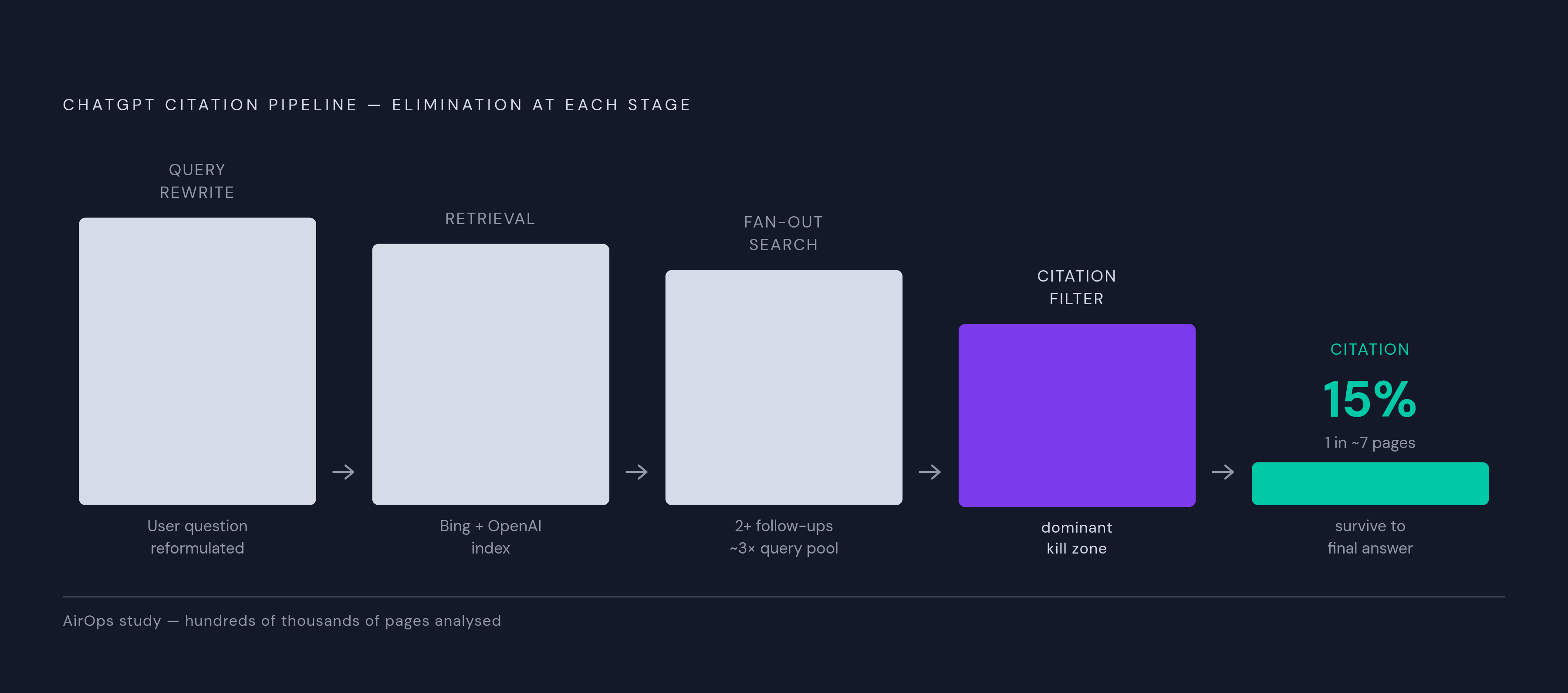
Retrieval and citation are separate filters, and a page can pass through the first one cleanly and still never make it through the second.
The pipeline runs in a fixed order. The model decides first whether a query needs live information. If it does, the model rewrites the user's question into one or more search-ready queries, sends those queries out to pull candidate pages from the web, evaluates each candidate against the specific claim it is trying to support, and finally attaches a small subset of those candidates to the finished response as citations. A query about a cancer drug, for instance, does not go to search as typed. Pages that do not match that rewritten query never enter the candidate pool in the first place, regardless of how well they covered the original topic, and Erlin's 2026 guide cites Authoritas (2025) finding that pages with FAQ schema and inline citations are weighted meaningfully higher in ChatGPT source selection than pages without these elements.
The scale of elimination at the citation stage is severe. An AirOps study spanning hundreds of thousands of pages across thousands of prompts, cited in Erlin's guide, found that ChatGPT cites only about 15% of the pages it retrieves, with the rest evaluated and discarded without appearing anywhere in the final answer. Retrieval itself is not even guaranteed to happen. A study of real LMArena conversations, also cited in KIME's analysis, found that roughly a quarter of GPT-4o responses were generated without fetching any online content, so no live sources were in play and no citation was possible.
Fan-out searching expands the set of pages that can earn a citation. Erlin's data shows that the overwhelming majority of prompts in the AirOps dataset triggered two or more follow-up searches, expanding the total query set to nearly three times the size of the original prompt count. Nearly a third of all cited pages in that dataset appeared only in those fan-out results and never appeared in response to the user's original query. A page tuned only for the obvious phrasing of a question misses a substantial share of the opportunities that actually generate citations.
A baseline infrastructure gate produces all of this. Bing functions as a primary retrieval layer for ChatGPT Search, working alongside OpenAI's own internal index and third-party data providers, and a page that blocks OpenAI's crawler, OAI-SearchBot, is simply ineligible for citation no matter how well it satisfies every other criterion. Crawler access and Bing indexing function as prerequisites rather than optimization levers in the usual sense. They are prerequisites, and failing them removes a page from consideration before any of the criteria discussed below ever come into play.
Direct question-answer match: the criterion with the highest weight at the citation stage
Among the criteria that determine which retrieved pages survive to citation, direct question-answer match carries the heaviest weight. CiteRanks' May 2026 guide assigns this criterion a "very high" rating and finds that pages structured explicitly as Q&A content receive a measurable bonus in citation probability. The logic follows directly from how the model evaluates claims rather than pages: if the task is matching a passage to a specific statement in the answer, a passage that states that answer immediately is easier to match than one that arrives at the same conclusion after several paragraphs of buildup.
A page can cover a topic with real depth and still lose at this stage if its answer sits buried six paragraphs in. That page may never get cited despite being comprehensive, simply because the model's extraction process never reaches the relevant sentence in a form it can cleanly lift and attach to the claim it's building. Coverage and placement are different variables, and only one of them determines citation at this stage.
FAQ schema exists almost precisely to solve this problem. It pre-formats question-answer pairs into a machine-readable structure that the model can extract directly, without needing to parse surrounding prose to locate the relevant sentence, which is why multiple independent studies of citation behavior identify it as a high-leverage element. The format does the work that otherwise depends on a writer's discipline in leading with the answer.
A fair objection follows naturally from this emphasis: wouldn't front-loading answers reward thin, shallow content over genuinely thorough work? Answer placement interacts with depth rather than substituting for it. The model appears to check both independently, favoring pages that lead with a clear answer and then back it with substantive support, which is a separate question from structure and depth as distinct, compounding signals rather than competing ones.
Content structure and schema as a signal the model can act on mechanically
Structure is not a stylistic preference here. It functions as a mechanical advantage, because structured markup and consistent organization give the model pre-parsed signals it can act on directly, without having to infer meaning from unstructured prose, and that is why pages with FAQ schema, attributed expert quotes, and clear heading hierarchies get selected more often than comparably authoritative pages that lack them. Every structural element reduces the amount of inferential work the model has to do to extract a usable answer, and less inferential work means a higher probability that the extraction succeeds.
Authoritas research cited in Erlin's 2026 guide found that pages combining FAQ schema with inline citations carry meaningfully more weight in ChatGPT's source selection than pages without those elements. A separate AirOps study of hundreds of thousands of pages found that pages built with JSON-LD markup posted a noticeably higher citation rate than pages without it, with Article, FAQPage, and HowTo schema standing out as the highest-leverage types. CiteRanks independently rates structured data presence as a "high" weight factor, specifically pointing to FAQPage schema as powerful because it hands the model pre-formatted question-answer pairs it does not need to construct itself.
Section length matters in a way that total word count does not capture. Erlin cites SE Ranking research finding that pages built around a moderate word count per heading, neither clipped fragments nor sprawling unbroken blocks, outperform both extremes. The model is hunting for self-contained, extractable chunks of information, and a heading structure that delivers those chunks at a consistent size gives it what it needs without forcing it to stitch together fragments or wade through excess text to find the relevant passage.
Attribution compounds this advantage. Pages carrying attributed expert quotes draw meaningfully more citations on average than pages relying on unattributed, generic assertions, because the model appears to treat a claim tied to a named expert differently from the same claim floated without a source. CiteRanks also flags entity clarity, meaning consistent, schema-defined naming of a brand, product, or organization, as a distinct high-weight signal in its own right, since clean entity naming prevents the model from misattributing a claim to the wrong source at the moment it extracts the passage.
Domain authority and topic-specific credibility as a retrieval-stage gate
Domain authority does most of its work at the front door. It determines whether a page enters the candidate pool in the first place, far more than it determines which page wins once several candidates are already competing for a citation, which makes authority necessary for consideration but insufficient for selection. Erlin's 2026 guide, citing SE Ranking research, describes this as a trust cliff: sites above a substantial referring-domain threshold are retrieved at dramatically higher rates than sites sitting well below that line.
Once a page clears that threshold and actually gets retrieved, the advantage of raw authority stops compounding. The same AirOps data shows that mid-authority pages, once inside the retrieval pool, post citation rates comparable to or even exceeding those of much higher-authority domains. A sprawling backlink profile gets a page through the door. It does not then determine who gets picked once everyone is standing in the room.
Authority, in any case, is not one universal score applied uniformly across every query. KIME's analysis describes it as domain-and-topic specific: a medical journal carries real weight on a health question, while a software review site carries weight on a question comparing SaaS products, and neither one's authority transfers cleanly to the other's territory. For sensitive categories such as health, legal, or statistical questions, SkyScale's research documents a strong, consistent preference for official government and institutional sources over commercial sites, even when the commercial site otherwise carries strong general authority.
One finding runs against intuition: Erlin cites SE Ranking data showing that domains with active profiles on third-party review platforms post substantially higher average citation counts, in the range of 4.6 to 6.3, compared with 1.8 for domains without any such presence. The model appears to read an active review-platform footprint as evidence of an operating, independently verifiable brand, rather than treating reviews as marketing collateral to be discounted. For a brand at moderate domain authority, this suggests a more productive investment than chasing backlinks: building structural and freshness signals, discussed in the sections above and below, alongside a credible third-party footprint, rather than assuming raw authority alone will eventually carry the day.
Recency as a content signal distinct from publication date
Freshness, to ChatGPT, is a claim the model checks against the actual content of a page, which means a page published yesterday but carrying stale figures can lose out to an older page that has been substantively revised with current information. Erlin's guide, citing Lureon.ai research, finds that content updated within the past 30 days receives substantially more citations than older material.
What counts as "updated," though, is evidential rather than cosmetic. Erlin draws a sharp distinction between a 2023 article that has had new 2026 data folded into its body and a 2023 article that carries the same timestamp but has never actually been touched. The model appears to look for current conditions reflected in the substance of the page itself, in updated statistics, refreshed examples, and revised claims, rather than trusting a "Last updated" stamp as sufficient proof on its own. A visible update date paired with content that has not actually changed does not carry the same weight as a date paired with genuinely revised material.
For trending or time-sensitive topics, SkyScale documents that the model applies stricter recency filters, at times limiting itself to sources published within recent days or weeks, and appends explicit temporal qualifiers like "current," "latest," or a specific year directly into its sub-queries. The practical requirement that follows is straightforward: refreshing the statistics, updating the examples, and revising the body of a page are not cosmetic housekeeping tasks. They are the evidence the model actually checks when deciding whether a page reflects present conditions or past ones.
A newer, more technical signal is beginning to surface alongside these content-based checks. An analysis cited in the broader research record on this topic points to retrieval speed, specifically responses returned in under 500 milliseconds, as an emerging discrete gate running in parallel with answer density. That finding is early rather than settled, but it suggests server performance may be developing into a freshness-adjacent factor operating at the retrieval stage itself.
Why earned media structurally outperforms brand-owned content across all four criteria
Direct answer match, structural clarity, topic-specific authority, and evidential freshness do not operate as four separate, unrelated filters. Together, they tilt the entire system toward third-party earned coverage and away from brand-owned content, because earned media tends to score strongly on authority, entity clarity, and independent attribution all at once, in a combination brand-owned pages structurally cannot replicate.
A University of Toronto study on generative engine optimization, published on arXiv in September 2025 and cited in KIME's analysis, concluded that AI search exhibits a systematic and overwhelming bias toward earned media over content a brand publishes about itself. The researchers' choice of the word "overwhelming" reflected a structural preference built into how these systems evaluate sources, a reflection of durable architecture rather than a marginal statistical edge that might narrow with time.
The dominant presence of Wikipedia, LinkedIn, Reddit, and established editorial domains across ChatGPT's source pool, as KIME documents, follows directly from this logic. Every one of those platforms is a venue where third parties make claims about a brand or entity. None of them is a venue where the entity makes claims about itself. Independent attribution, the very signal the citation stage rewards most consistently, is baked into the structure of earned coverage and absent by definition from brand-owned material, however well that brand-owned material is written or structured.
Smaller publishers, local newsrooms, and brand-owned pages face elimination at both gates in sequence, first failing to clear the authority threshold at retrieval, then failing the structure and answer-match tests at citation, and with only roughly 15% of retrieved pages surviving the citation stage at all, the number of pages that clear both hurdles is small. That two-stage filter is why structural optimization, covered earlier in this piece, matters disproportionately for smaller or less-established publishers: it is the one lever available once the authority gate has already been cleared or missed.
Commercial arrangements complicate this picture rather than resolving it cleanly. Publisher deals complicate the picture: a Poynter investigation of ChatGPT Search at its November 2024 launch found that of the first links featured in ChatGPT searches on November 1, most came from outlets with existing publisher partnerships. Earned media's structural advantage runs alongside a set of commercial relationships that shape which earned sources get surfaced first, and both forces are operating on the same source pool at the same time.
Sources
- ChatGPT
- ChatGPT Citation Sources: What Gets Cited in 2026
- ChatGPT Search Optimization (2026 Guide)
- How ChatGPT Chooses Its Sources: 2026 Guide - SkyScale
- How to Get Cited by ChatGPT in 2026: 7 Proven Strategies - CiteRanks
- How ChatGPT selects and cites sources
- How ChatGPT Decides Which Sources to Cite (and Why 85% Never Make the Cut)