How Large Language Models Select Citations
Models decide which citations to invent based on four distinct stages, each failing differently.

An LLM producing a citation looks like one action, but it is the output of four separate decisions stacked on top of each other, each with its own logic and its own way of failing. Most readers assume the model either already "knows" a source from training or goes out and fetches one from the web, as if citation were a single switch flipped on or off. The real process runs through four sequential stages: query interpretation, candidate retrieval, evidence selection, and response synthesis. Each stage picks from what the previous one handed it, and each can produce a correct-looking citation that is actually wrong in a different way. Understanding citation behavior means understanding which of these four stages shaped the result, because the fix for a stage-one error is not the fix for a stage-four error.
Stage one: how query interpretation determines whether retrieval happens at all
A study by Niimi using GPT-4.1 asked the model to produce a formatted citation on RFM analysis, a standard technique in marketing analytics. The model returned something that looked entirely legitimate: correctly formatted, plausible author names, a title fragment that read like real scholarship, a journal name that exists. None of it corresponded to an actual publication. Each piece, the authors, the title fragment, the journal, came from a different genuine paper, stitched into a single reference that corresponds to no actual publication. That result cannot come from a retrieval failure, because no retrieval happened. It comes from the first stage of the pipeline, query interpretation, where the model decides whether a question needs an external source.
This decision happens before any document is touched. The model classifies what kind of answer the query calls for, and if it concludes the question can be handled from what it already encodes in its parameters, it skips retrieval and generates directly from that internal store. When that happens, everything downstream, candidate pools, relevance ranking, evidence filtering, simply doesn't run. The citation that comes out is not a selection from a reference list; it's a string of tokens the model judged likely to follow a request for a citation, assembled because it resembles the shape of real bibliographic data, not because it points to any record the model checked. The GPT-4.1 case shows what that process produces when pushed: a composite that is internally consistent and completely fictitious, built from fragments of real scholarship recombined into something that never existed.
The implication for anyone trying to explain a citation failure is that the diagnosis has to start here. A system that never retrieved a source in the first place cannot be judged by the standards that apply to retrieval, ranking, or evidence filtering. If query interpretation decided the question was answerable from memory, the resulting citation is a probability artifact, not a sourcing error, and treating it as a sourcing error leads to the wrong fix.
Stage two: what candidate retrieval selects from
Once a query does trigger retrieval, the next question is what pool of documents the system is even choosing from, and that pool is neither fixed nor neutral. Different retrieval-augmented systems pull from different indexes, different document stores, different context windows, so the same question asked through two different retrieval setups can return two entirely different candidate sets before any ranking or filtering logic is applied. The documents a model never sees cannot be cited, no matter how authoritative they are.
Even within a single retrieved set, position affects which documents get cited. An evaluation using the FullCite framework, tested across three question-answering benchmarks, BioASQ, ASQA, and ExpertQA, found a strong primacy bias in how models used the documents handed to them. On BioASQ specifically, the large majority of citations pointed to only the first two of five documents available in the context. That pattern lines up with what's known in the field as the "lost in the middle" phenomenon: content placed in the middle of a context window gets systematically underweighted relative to content placed near the start or end, regardless of how relevant that middle content actually is to the question. A document can be retrieved, present in the context, and genuinely the best source for a claim, and still go uncited simply because of where it landed in the list the model was given.
This is where the deeper filtering logic takes over, deciding which of the retrieved candidates actually survive to appear in the final response.
Stage three: the criteria that determine which retrieved candidates survive to the response
Retrieval produces a pool of candidates. Evidence selection decides which of them make the cut, and that decision runs on relevance, authority, and recency signals that are far from evenly applied. Work by Algaba and colleagues examined GPT-4's citation behavior and found it tracks human citation patterns in broad strokes, but with a sharper tilt toward already-prominent scholars. That bias held even after the researchers controlled for publication year, title length, number of authors, and venue, ruling out the possibility that it was just an artifact of more-cited work being older, more collaboratively authored, or published in more visible journals. The model was simply more likely to select the well-known name over the equally relevant but less-cited one.
There's a fair objection to raise here: is that bias coming from the model, or from the reference data the model was trained on? Scholarly indexing itself under-represents low-visibility authors, researchers outside major institutions, and work published in smaller or regional venues, so a model trained on that record would reproduce the skew even without adding any of its own. Algaba et al.'s controls address some of this, and the honest answer is that model-level bias and source-level bias likely compound each other.
A separate strand of selection bias appears in political and news content specifically. Research on LLM citation of news sources found a clear tendency toward left-leaning outlets when coverage of the same event exists on both sides of the political spectrum, and traced that tendency to the identity of the media source itself rather than to anything distinctive in the content of the reporting. That's a structural pattern built into which sources the model treats as credible, not a one-off quirk of a particular prompt.
None of this answers how faithfully a selected source actually gets represented once it's chosen, and that's a separate question from selection altogether, handled at the next and final stage.
Stage four: why response synthesis can produce citations that look right but aren't
A citation can clear every earlier stage, get retrieved, get selected as relevant, and still be wrong at the point where the model actually writes the sentence that cites it. This is the stage where the term that gets used loosely in public discussion, hallucination, has to be defined precisely, because synthesis produces several distinct kinds of it.
One failure mode is what researchers call post-rationalization: the model generates its answer from what it already holds in parametric memory, then separately finds a retrieved document that superficially resembles the claim and attaches it as the citation. The output looks attributed, but it isn't. One line of research draws a sharp line between citation correctness and citation faithfulness: a cited document can genuinely support the statement it's attached to (correct) while having played no role in producing that statement (unfaithful), and the work finds a substantial share of citations generated through retrieval-augmented systems fall into exactly this category.
A framework called C²-Cite, presented at WSDM '26 (February 22–26, 2026, in Boise, ID), locates the mechanism behind this failure. Instruction-tuned models that are supposed to produce attributed output don't actually interpret what a citation marker means in context while they're generating text; they treat the marker as a generic placeholder symbol rather than as a pointer to a specific piece of retrieved knowledge. References end up disjointed even when the right documents were retrieved and sitting right there in context. FullCite's evaluation confirms a related gap from a different angle: models are reasonably good at identifying which document, at the whole-document level, is relevant to a claim, but they consistently fail to pin down the precise span within that document that actually supports the specific sentence being written. Attribution, in other words, tends to be coarse even in cases where nothing has been fabricated.
The scale of the resulting problem is documented directly. Sakai and colleagues, in work published in 2026, identified nearly 300 papers across the ACL, NAACL, and EMNLP conferences containing at least one hallucinated citation, almost all of them published in 2025. A separate analysis by Ansari looked at hallucinated citations across a sample of papers from NeurIPS 2025 and found that most were total fabrications, with every case in the sample showing corruption across multiple metadata fields at once, author names, titles, venues, years, all failing together. Ansari's taxonomy gives the failure modes names: total fabrication, partial attribute corruption, identifier hijacking, placeholder hallucination, and semantic hallucination, each traceable to a different breakdown point within synthesis. That compounding pattern, errors landing across several fields simultaneously rather than in one isolated spot, is precisely what makes these citations hard to catch after the fact: a check that verifies only the author name or only the journal title can still miss a reference that's wrong everywhere at once.
Where pipeline failures originate
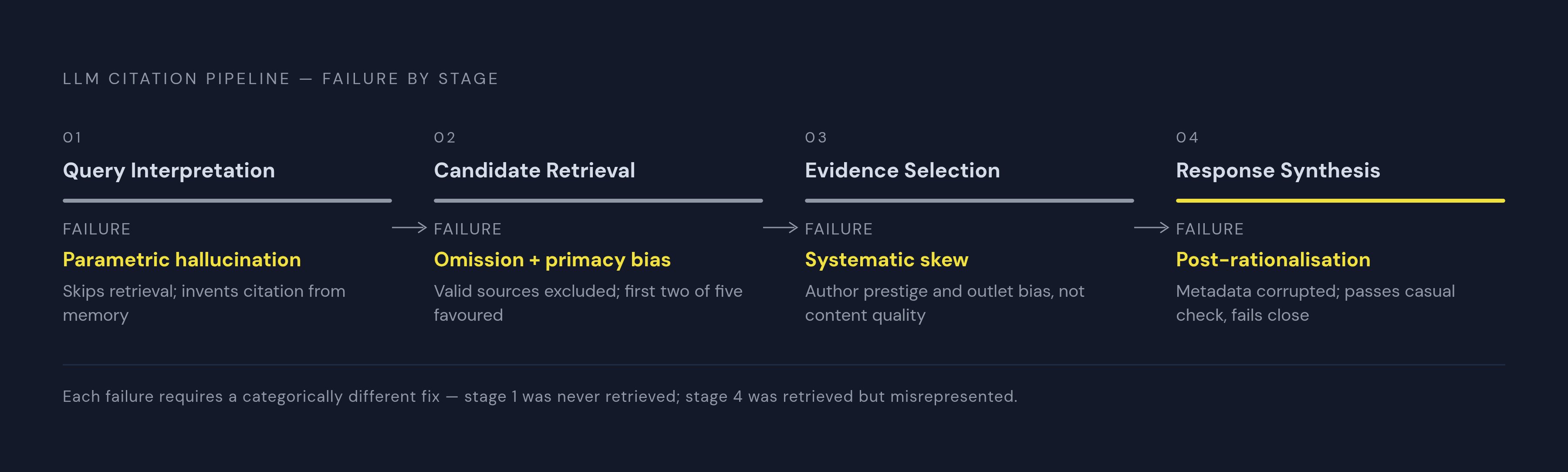
Lay the four stages side by side and each one leaves a distinct fingerprint on the failure it produces. A stage-one misclassification, where the model decides retrieval isn't needed, produces parametric hallucination: fluent, plausible, and entirely unanchored to any real document. A stage-two retrieval gap produces omission, a valid source that simply never entered the candidate pool and so could never have been cited. A stage-three selection bias produces systematically skewed attribution, where real, retrievable sources were available but the more prominent or more politically aligned one got chosen over an equally valid alternative. A stage-four synthesis failure produces the post-rationalized or metadata-corrupted citations described above, output that passes a casual glance and fails on inspection. Compound failures happen when an error at one stage cascades into the next, a bad retrieval set making a bad selection more likely, for instance, which makes the resulting synthesis harder to verify.
The measured range of hallucination rates across the 2023–2025 research record reflects how differently systems fail depending on where their weakest link sits. One review of the literature documents hallucination rates spanning from under a fifth of generated citations to over nine-tenths, depending on the model and the conditions tested. That spread means there's no consistent safety floor that holds across vendors or system designs; a given system's failure profile is set by whichever stage in its pipeline is weakest.
Retrieval-augmented generation narrows the problem without closing it. Benchmarking work shows that more advanced RAG setups reduce hallucination rates compared with naive RAG implementations, but that improvement comes with a cost: more advanced setups tend to eliminate abstention, the system's ability to simply say it doesn't have enough evidence to answer. In domains where "I don't know" is the correct and safest answer, that trade-off matters as much as the raw hallucination rate does.
Citations that are correct but causally disconnected from what the model actually wrote don't get fixed by better retrieval alone, because the failure sits in how the model interprets citation markers during generation, not in what documents it had access to. C²-Cite's results at WSDM '26 address that directly: encoding the actual content of a retrieved document into the representation of its citation marker, rather than treating the marker as an interchangeable placeholder, improved both citation quality and response correctness over the prior best-performing approach. Two other efforts tackle the same stage-four problem from outside the generation process itself. VeriCite, presented at ACM SIGIR-AP 2025 and designed by Haosheng Qian and colleagues, validates citations after the fact by rigorously checking the evidence behind them, tested across five open-source models and four datasets. CiteFix, from the ACL 2025 Industry Track, takes a similar post-processing route, cross-checking generated citations against the retrieved articles using keyword and semantic matching, a fine-tuned model scored with BERTScore, and a lighter-weight LLM-based check, and reports a meaningful improvement in overall citation accuracy. These represent two different strategies for the same stage: one changes how the model generates citations, the other verifies citations after the model has already produced them.
What the pipeline framework means for content producers
Visibility in LLM citations is set by structural and distributional factors at each of the four stages, not by the quality of the source content alone, and that has direct consequences for anyone whose work might be cited by one of these systems. At stage one, content that signals clear topical authority through its own structure is more likely to trigger retrieval in the first place rather than getting bypassed in favor of the model's parametric memory. At stage three, the Algaba findings mean that being correct is not the same as being cited; already-prominent sources get selected disproportionately even when a less-known source is equally relevant. Visibility compounds on itself in ways that have little to do with the merit of any individual piece of work.
For researchers and academic authors, there's a sharper and more specific warning buried in the 2026 findings from Zhao and colleagues. Hallucinated citations in published academic work don't distribute randomly across the literature. They concentrate in manuscripts carrying linguistic signatures associated with AI-assisted writing, and they concentrate disproportionately among early-career authors. That turns the pipeline's failure modes into a professional risk rather than a purely technical curiosity: a hallucinated citation surfacing in a submitted or published paper carries consequences for the author's record regardless of whether the underlying research was sound.
A further implication comes from Hou and colleagues' study on how citations function in the preference data used to train these systems. Human judges evaluating model outputs tend to prefer fewer citations overall, but more diverse ones, while LLM judges performing the same evaluation show different citation preferences. That difference means citation behavior is produced not only at the moment of inference, by the four-stage pipeline described here, but also earlier, during post-training, through reward modeling that bakes in whatever citation preferences the judges, human or machine, happened to express. That creates a feedback loop: today's citation patterns shape the preference data used to train tomorrow's models, and tomorrow's models then reproduce and reinforce whatever selection habits, prominence biases, and political tilts were present in the data that trained them.
The TREC 2025 RAG Track points to where the field is trying to go in response to all four stages at once: its focus on sentence-level, verifiable attribution to a standardized document corpus aims at transparency down to the level of the individual claim, not just the document. Most deployed systems today don't operate at that level of granularity. The gap between where the field is headed and where current pipelines actually sit is the clearest measure of how much work remains before a citation from an LLM can be trusted the way a citation from a human author can be.
Sources
- C$^2$-Cite: Contextual-Aware Citation Generation for Attributed Large Language Models
- Explicit Evidence Grounding via Structured Inline Citation Generation
- Hierarchical Memorization in Large Language Models: Evidence from Citation Generation
- LLM hallucinations in the wild: Large-scale evidence from ...
- On the Role of Citations in Preference Data
- Who Gets Cited? Gender- and Majority-Bias in LLM-Driven Reference Selection
- Testing Our Foundations: Citation Trends, Errors, and Emerging Hallucinations in the Computing Education Literature
- Detecting and Correcting Reference Hallucinations in Commercial LLMs and Deep Research Agents